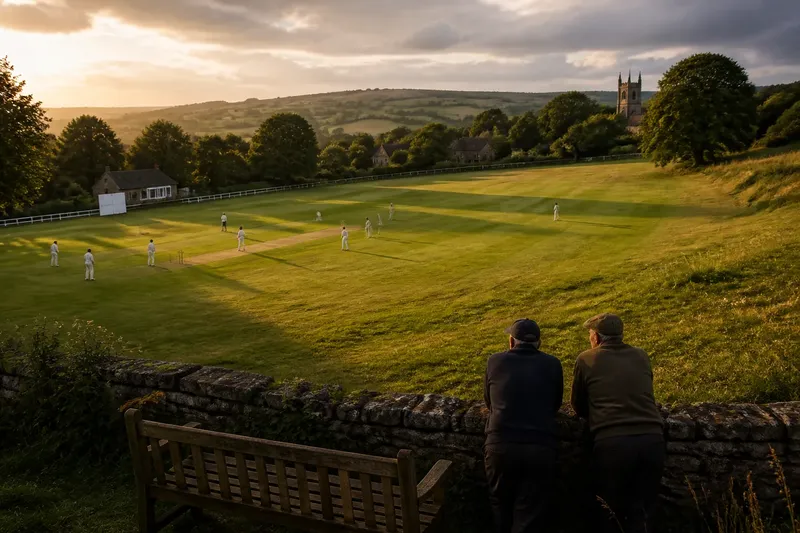
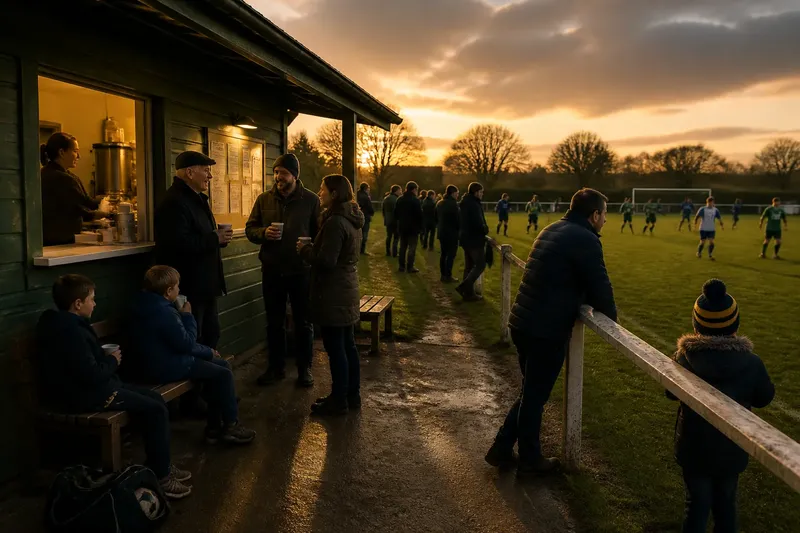
Why a Field Boundary Shapes More Than the Playing Area
A field boundary reveals where play belongs and how people share a rural ground. Learn to read gates, paths and margins beyond the marked pitch.
The common mistake is to treat a field boundary as the edge of the game and nothing more. On a rural ground, that can obscure where players enter, where spectators should stand and which parts of the land still have another use. A boundary is not merely a line around play; it is a visible arrangement of permission, movement and attention.
That arrangement may be made by a hedge, ditch, fence, tree line, road or the simple change from close-cut grass to rougher ground. The touchline or goal line is only one layer. To read a playing place properly, notice how the marked area sits inside the larger field, and how people approach and move around it.
The boundary has several different jobs
A sports ground can have a legal playing boundary, a physical property boundary and an informal edge where people naturally stop. These may coincide, but often they do not. A painted line tells players where the ball is in play; a hedge may mark the edge of a holding; a worn track may show the route people actually use.
Keeping those distinctions in mind prevents a common misreading. A ball crossing a touchline may be out of play while remaining well inside the field. A spectator standing beyond the marked area may still be on ground used for grazing, access or storage. The visible line settles one question, not every question about the space.
Look for changes in surface and use as well as built features. Close-mown turf can give way to longer grass, a gravel lane or a damp strip near a ditch. Such transitions help show where regular play is concentrated and where the ground is less intensively used.
Read the ground from its approaches inward
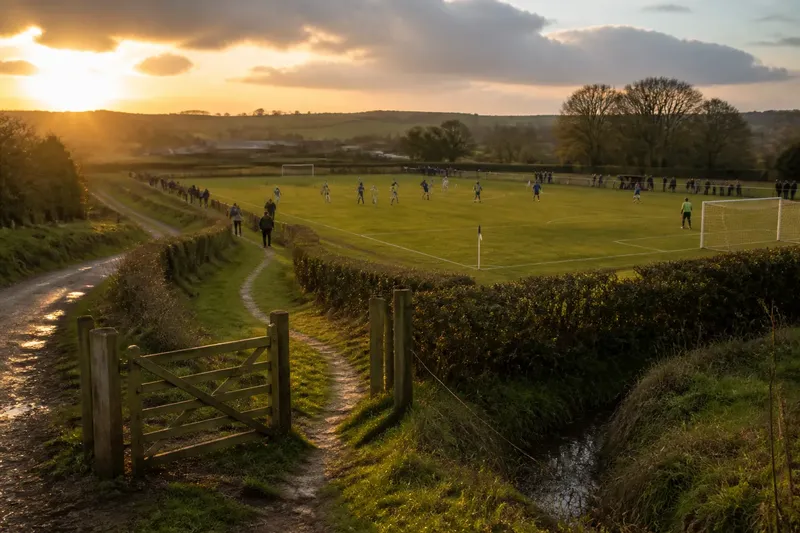
Start at the route people take to reach the playing area. A gate opening onto a lane, a gap in a hedge or a track across the field can indicate the usual entrance. If the marked pitch is set well back from that route, the distance between them may separate arriving visitors from active play without requiring a formal barrier.
Then notice what lies between entrance and pitch. A broad grass margin may accommodate walking, waiting or occasional overflow. A narrow passage between a fence and the touchline may be a circulation route, not a place to gather. A ditch or steep bank may make the apparent open edge difficult to cross. The layout gives clues, but it does not tell you that every route is open to everyone.
Imagine a small ground where the gate opens beside a farm track, while a mown path curves toward the pitch and a hedge runs along the opposite side. If visitors follow the path, they can reach the playing area without crossing the track’s working route. The expected observable result is a clear division between the approach and the place where people watch or play, even though there is no elaborate set of signs.
For a first visit, follow the evident route rather than taking the shortest line across the grass.
Margins show how a field is shared
The strip beyond a playing line is often where competing uses become visible. It may carry foot traffic, give room for players to retrieve a ball, protect a hedge from trampling or remain available for another activity. Its condition can reveal how intensively it is used: flattened grass suggests repeated passage, while uneven ground or established plants may signal a margin people generally leave alone.
Do not assume that an untended-looking strip is spare land. It may drain water, shelter wildlife, preserve access to a gate or simply form part of a neighbouring use. Likewise, a wide, even expanse is not automatically an invitation to spread out. The ground’s appearance is evidence of use, not a substitute for local understanding.
Sharing is often expressed through small spatial choices. A route might skirt the back of a goal rather than run through the playing area. Spectators may collect on one long side because the other side borders a lane or hedge. A separate entrance can keep routine access distinct from match-day movement. These arrangements can be modest and still make the use of the field legible.
Where the ground has several users, notice whether their paths cross or run alongside one another. That is often more revealing than the size of the marked area.
Edges shape movement and sightlines
A boundary influences where people stand and what they can see. A fence may keep a line of spectators back, while a low bank offers a raised view. Trees can frame one end of the ground and obscure another. A hedge may make the field feel enclosed even when the playing area itself is broad.
For players, the same features affect how the space feels in motion. A line close to a hard surface, ditch or dense hedge can make the usable margin seem tighter. An open end may invite a longer view beyond the pitch. These are not changes to the rules; they are part of the physical setting in which the rules are played.
Edges also guide attention. A gate draws the eye toward an entrance; a sheltering tree or a line of parked bicycles can become a meeting point without being part of the formal layout. The important distinction is between a place that looks socially useful and one that is actually available for standing or access. Ask, follow any local signs, and avoid blocking gates or routes.
Seasonal change makes the edges easier to read
A boundary is not equally visible throughout the year. In leafy months, a hedge can form a solid screen; after leaves fall, gaps and paths behind it may become apparent. Wet weather can make a low-lying margin visibly soft, while a dry spell may leave it firm enough to disguise its usual role. Grass height changes the impression of where one use ends and another begins.
These shifts matter because the field is a piece of countryside, not a diagram fixed in place. A route that seems obvious in one season may be muddy or obscured in another. A ditch may be hidden by long vegetation. A gate may be easier to spot when surrounding growth is low. Read the present conditions rather than relying only on what the ground looked like on a previous visit.
Where access or permitted use depends on local arrangements, follow posted notices and ask the club or land manager if the boundary is unclear. The right answer can depend on the ground’s rules and the landholder’s instructions.
What questions help you read a playing ground?
Does the touchline mark the edge of the whole field?
No. It marks the playing area used for that game, while the wider field may include routes, margins and other land uses. Look for separate physical edges such as fences, hedges, ditches and gates.
How can I tell where spectators usually stand?
Look for a clear, established area that does not obstruct entrances or narrow routes. The layout may suggest a suitable place, but signs or guidance from the club take precedence over guesswork.
Why might a ground have a wide strip beyond the playing line?
The margin can leave room for movement, separate play from a hedge or path, or serve another use of the land. Its purpose is not always visible, so treat it as part of the shared layout rather than automatically as spare space.
What should I notice on a first visit?
Notice the entrance, the route from it to the pitch, and any features that divide the playing area from neighbouring ground. Then check whether paths, signs or local guidance clarify how visitors should move around.
Read the boundary as a map of everyday use
A rural playing ground can look simple from a distance: a rectangle of cut grass within a larger field. Up close, its edges reveal a more useful picture. Lines define the game; gates and paths organise arrival; margins absorb movement; hedges, banks and ditches distinguish one kind of use from another.
That is why a field boundary shapes more than the playing area. It helps explain how sport fits into a working landscape and where one person’s route meets another’s space. On your next visit, trace the way in from the gate before looking only at the pitch. The ground’s arrangement may tell you where play happens, but it also shows how to share the place without mistaking every open patch for an invitation.